
At a glance
The client
Our client is a Sonderpädagogin — a special-education teacher — based in Bonn, Germany. She had spent years working with children in a specialised school setting and had identified a recurring need for a small, modular, fabric-based teaching tool.
The trigger came from her own daily experience. Teachers in her school move between different teaching buildings across a campus, carrying different teaching materials for different subjects and lesson plans. Existing bags either forced everything into a single compartment (so materials got mixed up) or were too rigid to swap configurations between lessons.
She started designing a modular bag — one that could be reconfigured for different teaching topics, with internal modules that hold different sets of materials and can be swapped in seconds before walking to the next class. The product is built first for educators like herself, who teach across multiple subjects in different rooms.
She was not a designer by training. She had no factory contacts. She had no tech pack. What she had was: a clear idea of what the product needed to do, photos of references, a measured size constraint, and the patience to iterate.
This is the most common kind of project we see — and one of the most rewarding to run.
"Ich bin eine Lehrerin und habe diese Idee schon länger im Kopf. Ich weiß nicht, ob das herstellbar ist."— "I'm a teacher and have had this idea in my head for a while. I don't know if it can be manufactured."
The brief
The first email arrived in August 2025. It was in German. The materials she sent included:
- A short written description of what the tool does and how it's used in classrooms.
- Two reference photos of similar (but unsuitable) products.
- Approximate exterior dimensions in centimetres.
- A sketch of the internal modular structure.
- A note that the product would carry a small printed brand mark and a custom internal label.
That's it. No tech pack. No CAD files. No supplier list. By the standards of most factories, this would not be considered a "ready" project. By our standards — for a first-time founder who has clearly thought about her end-user — it was a strong starting point.
Feasibility & first conversation
Our first reply was not a quote. It was a structured set of questions:
- How does the modular structure attach? (Snap? Velcro? Magnetic?)
- Does the tool need to fold flat for storage when not in use?
- What's the priority — durability for daily school use, or tactile/sensory finish for the children?
- Are the colours flexible, or tied to existing visual material?
- What's the expected lifespan in classroom use?
Each of those questions, answered, would change the structure, the materials, and the cost. Without them, any quote we gave would be a guess — and a guess sets up everyone for disappointment later.
Within a week of back-and-forth, we had: a confirmed material direction, a confirmed structural approach, and an internal sign-off from our China-side production team that the product was producible at the small batch scale she had in mind.
Building the first prototype
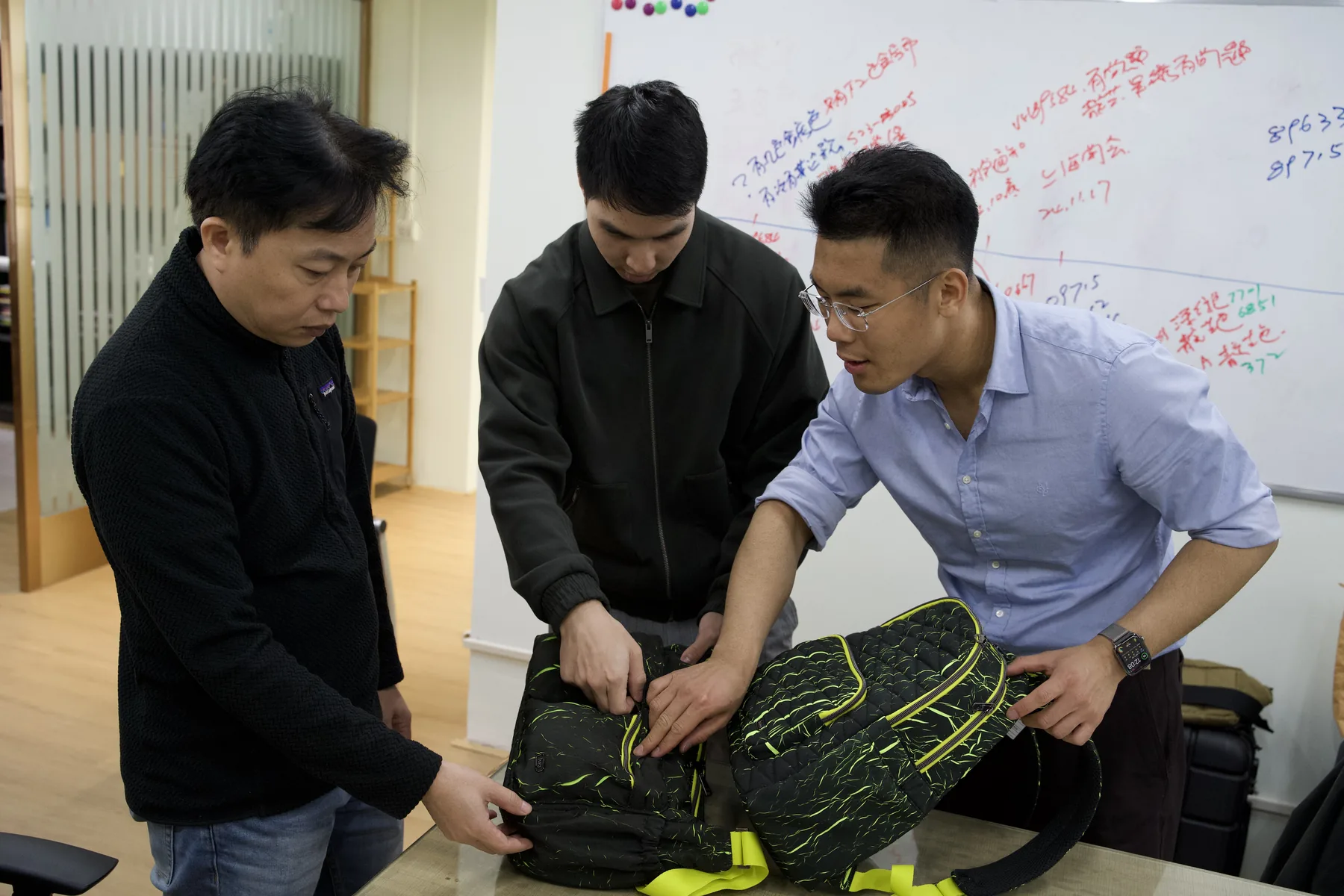
By late August, we were coordinating with our partner factory's sample room. The work involved:
- Translating her German notes and sketches into a working internal spec for the cutting and sewing teams.
- Sourcing fabric swatches in three weights, plus matching internal materials.
- Assembling a hardware shortlist: zipper pull, internal label, and the attachment mechanism for the modular section.
- Confirming the printing approach for her brand mark.
By mid-October, the first prototype was complete. We sent photos for review before shipping. Two small details surfaced — clarified by email — and the prototype was shipped to Bonn.
"Vielen Dank für den ersten Prototypen. Das Ergebnis ist schon viel näher dran, als ich erwartet hatte."— "Thank you for the first prototype. The result is already much closer than I had expected."
From first to second prototype
The first prototype was close, but not done. Over four weeks of structured feedback, the changes for the second prototype came together:
- Material swap on one panel — moving from one fabric weight to another for tactile reasons.
- Refinement of the modular attachment — improving the user experience of removing and re-attaching the inner section.
- Internal label revision — colour and placement fine-tuned.
- Zipper detail upgrade — selected from a small set of alternatives we shared with reference photos.
- Hardware finish update — to match a colourway revision.
The second prototype was completed in January 2026 and shipped together with colour and material samples for any future production decisions.
"Ich bin sehr zufrieden mit dem Ergebnis. Es sind viele sehr schöne Details umgesetzt worden."— "I'm very satisfied with the result. Many really beautiful details have been implemented."
Structured iteration
One thing that helped this project work was a small process detail: every revision was tracked in a shared Google Sheet, with a row per change, columns for description, why, status, and reference photo / sketch.
For a first-time founder running this kind of project on top of a full-time teaching job, this was important. It meant no detail was lost between emails. It meant when she had a question two months later, she could find the answer in one place. It meant we — running the project from Munich and coordinating Shanghai-side — also had a single source of truth.
It's a small thing. But on small projects with high attention to detail, the small things are usually what determines whether the project is enjoyable or stressful for both sides.
What worked — and what we learned
What worked
- German throughout. The client wrote in her own language, asked questions in her own language, and expressed feedback nuances she could not have done in English. We replied in German. Translation friction was zero.
- Small batch, sampling-led. Two paid prototypes was the right scale for this project. There was no pressure to commit to production before the design was settled.
- Honest constraints early. When something wasn't possible at her target scale, we said so — and proposed alternatives. No false promises.
- The shared sheet. Tracking revisions in one place removed the "didn't I send you that?" friction that derails so many small projects.
What we learned
- Educators make excellent first-time founders. They observe behaviour for a living. Their briefs may not be fluent in design vocabulary, but they're fluent in function.
- Anonymity matters. Not every project becomes a public-facing brand. Some projects are quiet, slow-built, and intended for a specific community. Keeping the client's privacy is part of the work.
- Patience compounds. Five months from first email to "sehr zufrieden mit dem Ergebnis" feels long compared to a generic factory's "samples in 2 weeks!" — but the result is a thing that actually works.
If your project sounds similar
We work on a small number of these consultation-led projects at any given time. If your project is:
- A first or second physical product for a specialised audience,
- Without a polished tech pack — but with a clear idea of what it needs to do,
- Best discussed in German, English, or Chinese,
- And likely to need 1–2 sampling rounds before a small production batch,
...we'd be a good fit. Send what you have via the contact form. The first reply will be questions, not a quote.
You can also read our broader guide on finding a custom bag manufacturer in Europe, or look at the 8-step process we use across all sampling projects.